I Learned Every Piano Scale in 30 Days — Here’s What Actually Changed My Playing
Thirty days ago, I couldn’t play a proper C major scale without stumbling. Today, I can move through all twelve major scales fluently, and my piano playing has transformed in ways I never expected. If you want to learn piano scales efficiently, my journey might help you shortcuts the same process that took me years to figure out on my own.
Let me be clear from the start—this isn’t about becoming a virtuoso overnight. This is about understanding why scales matter, how to practice them effectively, and what actually changed in my musicianship after committing to daily scale work. The results surprised me, and they might surprise you too.
Why You Should Learn Piano Scales (And Not Skip Them)
Every piano teacher worth their salt will tell you to practice your scales. Most students groan, practice halfheartedly, and wonder why they bother. I was one of those students for years. I wanted to play beautiful music, not repetitive exercises.
Here’s what I finally understood: scales are the grammar of music. Just as you cannot write compelling sentences without understanding grammar, you cannot play interesting music without internalizing scales. When you learn piano scales properly, you gain three essential benefits that transform your playing:
- Finger independence and strength — Your fingers learn to work together while maintaining proper technique
- Music theory comprehension — You start hearing relationships between notes that previously seemed random
- muscle memory for key signatures — Playing in different keys becomes natural rather than intimidating
Once I understood these benefits, practicing scales stopped feeling like punishment and started feeling like investment.
The 30-Day Framework That Actually Works
I didn’t invent this framework from scratch. I studied how professional pianists practice scales, combined that knowledge with current learning science about motor skills development, and created a 30-day plan that progressive builds competence without overwhelming burnout.
Week 1: Building the Foundation
Days 1-7 focused exclusively on hand position, posture, and the C major scale. Yes, just C major. Most people rush past this stage, which is precisely why they struggle later. I spent fifteen minutes daily playing C major slowly—very slowly—with a metronome set at 60 beats per minute.
I focused on these specific elements during week one:
- Proper curved finger position
- Relaxed wrists and shoulders
- Even note volume throughout the scale
- Clean transitions between ascending and descending
By day seven, C major felt effortless. That feeling was the first sign that the system was working.
Week 2: Expanding the Major Family
Days 8-14 introduced G major, D major, and F major. Why these three? They share similar finger patterns to C major, making the transition smoother. Each new scale received the same careful attention I gave C major during week one.
I practiced each new scale for ten minutes daily while maintaining my C major proficiency with five minutes of review. By the end of week two, I could play four major scales without sheet music in front of me.
Week 3: Completing the Major Scale Circle
Days 15-21 covered the remaining five major scales: A, E, B, Ab, and Eb. These scales introduced more challenging finger patterns, particularly the scales with more black keys. I had to adjust my hand position slightly for each, and some days felt frustrating.
That frustration taught me something crucial: plateaus are part of the process, not signs of failure. I pushed through by slowing down further and focusing on problem spots rather than rushing to maintain speed.
Week 4: Entering the Minor World
Days 22-30 introduced natural minor scales. I started with A minor (the relative minor of C major) because the finger patterns felt familiar. From there, I worked through D minor, E minor, and G minor.
The revelation during week four was understanding how major and minor scales relate. Once I saw those relationships, learning new scales became exponentially easier. This connection is precisely why learning scales systematically creates better musicians than memorizing individual patterns ever could.
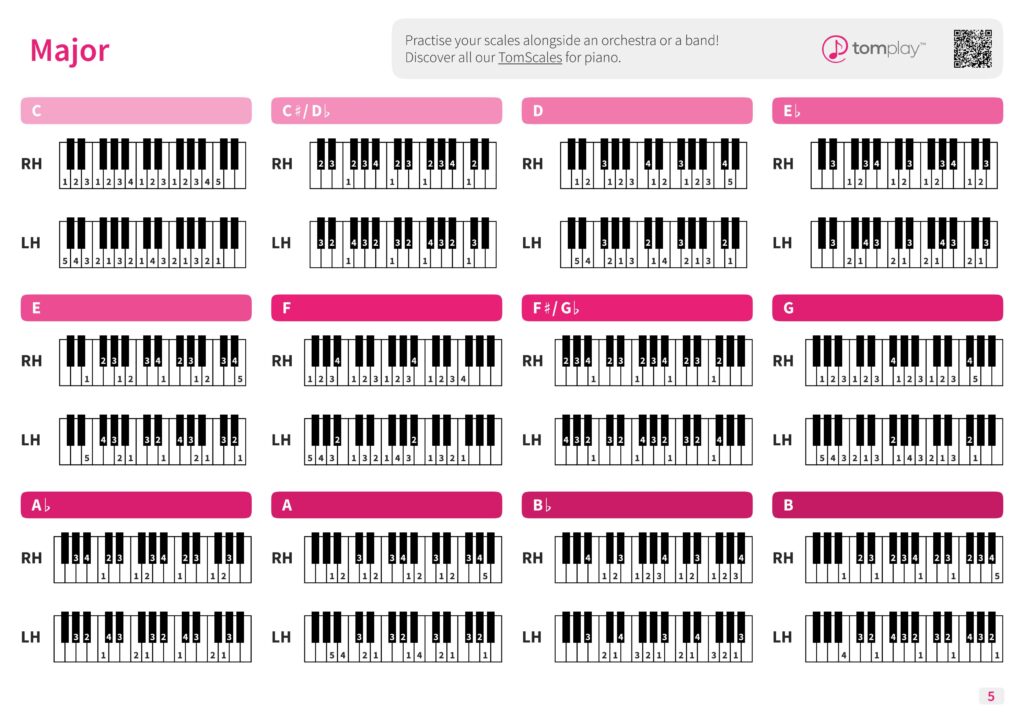
The 12 Major Piano Scales: Quick Reference
For those ready to begin their own 30-day challenge, here is a structured table of all twelve major scales with their key signatures and starting notes:
| Scale Name | Starting Note | Key Signature | Black Keys Used |
|---|---|---|---|
| C Major | C | No sharps or flats | None |
| G Major | G | 1 sharp (F#) | F# |
| D Major | D | 2 sharps (F#, C#) | F#, C# |
| A Major | A | 3 sharps (F#, C#, G#) | F#, C#, G# |
| E Major | E | 4 sharps (F#, C#, G#, D#) | F#, C#, G#, D# |
| B Major | B | 5 sharps (F#, C#, G#, D#, A#) | All except E |
| F Major | F | 1 flat (Bb) | Bb |
| Bb Major | Bb | 2 flats (Bb, Eb) | Bb, Eb |
| Eb Major | Eb | 3 flats (Bb, Eb, Ab) | Bb, Eb, Ab |
| Ab Major | Ab | 4 flats (Bb, Eb, Ab, Db) | Bb, Eb, Ab, Db |
| Db Major | Db | 5 flats (Bb, Eb, Ab, Db, Gb) | All except C |
| Gb Major | Gb | 6 flats (Bb, Eb, Ab, Db, Gb, Cb) | All except D |
What Actually Changed in My Playing
Beyond the obvious improvement in scale fluency, something remarkable happened during those thirty days. My overall piano playing elevated without direct practice on songs or repertoire pieces.
Here is what transformed specifically:
Chord Transitions Became Natural
Once I understood how notes relate within scales, I could predict where chords would go next. Playing a ii-V-I progression in any key became effortless because I understood the mathematical relationship between those chords within the scale structure.
Improvisation Finally Made Sense
For years, improvisation felt like guessing. After learning piano scales systematically, improvisation became about choosing notes from a familiar palette rather than randomly guessing which black key to press next.
Ear Training Accelerated
When you play scales daily, your ear calibrates to pitch relationships automatically. I started hearing intervals correctly within two weeks and could identify chord qualities by the end of the month.
Common Mistakes When You Learn Piano Scales
My journey wasn’t without setbacks. I made several mistakes that slowed my progress, and you can avoid them:
- Practicing too fast too soon — Speed comes from accuracy, not the other way around
- Skipping the metronome — Without a metronome, you cannot measure improvement objectively
- Playing without proper hand position — Bad habits formed early are incredibly difficult to break later
- Neglecting review — Old scales fade quickly if you don’t maintain them while learning new ones
Frequently Asked Questions About Learning Piano Scales
How long should I practice piano scales each day?
Fifteen to twenty minutes daily produces excellent results. Consistency matters more than duration. Even ten focused minutes trump an hour of distracted practice.
Should I learn major scales before minor scales?
Yes, major scales should come first. They provide the foundation for understanding minor scales as variations or relatives of the major system.
Do I need to learn all twelve major scales?
Absolutely. Professional pianists can play in any key fluently. Limiting yourself to familiar keys restricts your musical vocabulary significantly.
Should I use sheet music or memorize scales?
Use sheet music initially to ensure accuracy, then transition to memory work. By the end of your 30-day challenge, playing scales from memory should feel natural.
What metronome speed should I start at?
Begin at 60 beats per minute for quarter notes. Only increase speed when you can play each scale perfectly five times in a row without any mistakes.
Can adults successfully learn piano scales in 30 days?
Adults often learn scales faster than children because they understand the purpose behind the practice and can self-correct more effectively. Age is not a barrier.
Conclusion: Start Your 30-Day Challenge Today
Learning all twelve major scales in thirty days is absolutely achievable if you commit to daily practice and focus on technique over speed. The investment pays dividends far beyond scale proficiency—you’ll become a more complete musician capable of playing in any key, understanding theory intuitively, and approaching improvisation with confidence.
The transformation I experienced wasn’t about showing off scale speed. It was about gaining the foundational fluency that makes everything else in piano playing easier. Scales aren’t busywork designed to bore students. They are the essential building blocks that unlock musical understanding.
If you’ve been skipping your scale practice or approaching it haphazardly, I encourage you to try the 30-day framework I’ve outlined here. Give yourself permission to go slowly during week one. Trust the process. The results will follow.
Your future self—the pianist who plays fluently in any key and understands music theory intuitively—will thank you for starting today.
Read Related Articles
Want to continue your musical journey? Explore our collection of guides on piano technique, music theory fundamentals, and practice strategies that professional musicians use to master their instruments.
Contact us for more information about personalized piano instruction, practice programs, or to schedule a consultation with our teaching team. Whether you’re a complete beginner or looking to refine your existing skills, we’re here to help you achieve your musical goals.
Ready to transform your piano playing? Get in touch with us today and take the first step toward becoming the musician you’ve always wanted to be.