AI Business Authority Part 13: The Strategic Maturity Framework
Direct Answer: Sustainable AI business authority emerges from strategic AI integration that amplifies authentic human expertise, not from scattered tool adoption. This maturity framework helps you assess your current position, identify critical gaps, and execute a structured plan to transition from experimental AI tactics to strategic authority positioning.
Introduction: The Pivotal Transition Point
If you’ve progressed through the foundational AI implementations covered in Part 1 through Part 12 of this AI Business Authority series, you’ve likely experienced both the promise and the frustration of early AI adoption. You’ve tested prompts, generated content, and perhaps seen some initial wins. But something feels incomplete—a sense that your AI efforts lack strategic coherence.
Part 13 represents the pivotal transition point in your AI authority journey. This is where strategy overtakes tactics, where scattered experiments transform into systematic advantage, and where AI becomes a genuine force multiplier for your business authority rather than merely a content production shortcut.
The core thesis of this article is straightforward: sustainable business authority requires strategic AI integration paired with authentic human expertise. Neither component alone typically suffices. AI without human guidance tends to produce generic outputs that struggle to differentiate. Human effort without AI leverage often cannot achieve the production velocity and insight depth required for market authority in today’s competitive landscape (Harvard Business Review, 2023).
Throughout this article, you’ll encounter the concept of “AI authority maturity”—a measure of how deeply AI capabilities are woven into your business strategy versus how frequently they’re deployed as isolated tactical tools. By the end, you’ll have a clear picture of where you stand, where the gaps exist, and exactly how to close them through a structured 90-day acceleration plan.
Understanding the AI Authority Maturity Gap
Many businesses plateau after initial AI adoption because they mistake tool adoption for strategic transformation. They’ve integrated AI writing assistants, perhaps automated some workflows, and generated more content than ever before—yet authority metrics remain flat or decline.
The Experimentation Plateau
The difference between AI-assisted tasks and AI-integrated strategy is the difference between using a hammer and understanding architecture. Businesses stuck in experimentation treat AI as a faster typewriter—a way to produce more content with less effort. Businesses that break through to strategic integration treat AI as a thinking partner that transforms how they understand their market, communicate their expertise, and build lasting authority (McKinsey, 2024).
Consider the distinction in practice:
- AI-Assisted Tasks: Using GPT-4 or Claude to draft blog posts based on generic prompts, running competitor content through AI to identify topic gaps, generating social media captions at scale.
- AI-Integrated Strategy: Using AI to synthesize proprietary customer conversation data into market positioning insights, deploying AI systems that learn from engagement patterns to refine authority messaging, building automated workflows that connect market intelligence to content strategy in real-time.
The plateau occurs when businesses optimize for output volume rather than output impact. They measure success by articles published rather than authority gained. They chase content quantity because it’s measurable, while authority-building activities that actually move the needle—strategic positioning, relationship cultivation, original insight development—remain manual and unsystematic.
Why Scale Fails Without Strategy
Businesses that struggle to scale AI authority efforts typically exhibit common patterns: content pipelines that produce but don’t convert, social presence that posts but doesn’t position, keyword targeting that ranks but doesn’t build reputation. The gap between activity and authority is where strategic integration lives.
Understanding this maturity gap is the first step toward closing it. The framework presented in the next section provides a structured way to assess your current position and chart a path toward strategic AI authority.
The Strategic AI Authority Maturity Model
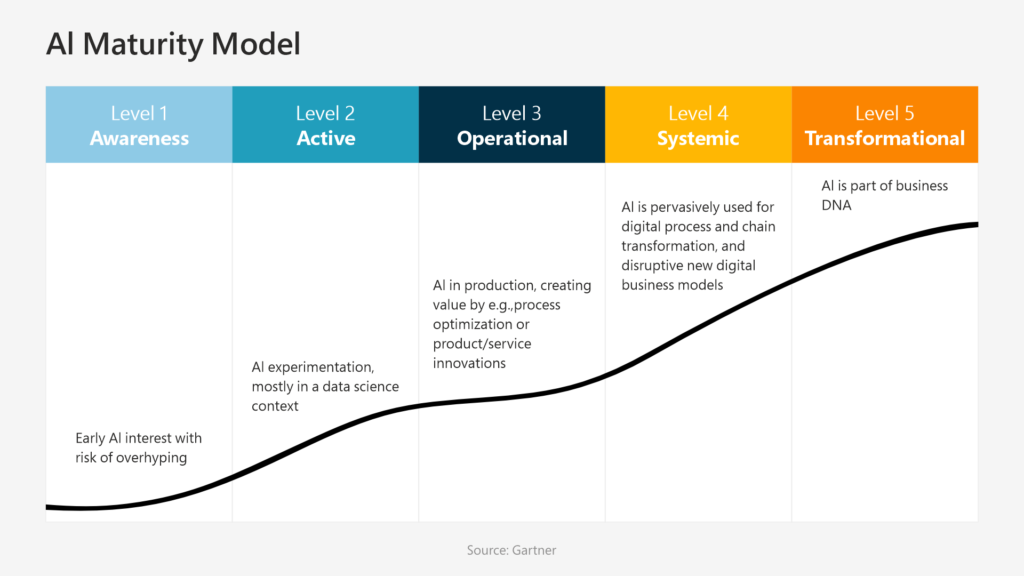
The maturity model below identifies four distinct levels of AI integration for business authority. Self-assessment against these levels reveals your current position and highlights the specific capabilities required to advance.
Level 1: Reactive AI Use
At this foundational level, AI is deployed ad-hoc when specific needs arise. Content creation happens manually with AI occasionally filling gaps. AI usage is fragmented—no standardized workflows, inconsistent prompting approaches, and no systematic measurement of AI’s impact on authority outcomes.
Characteristics:
- AI tools used reactively rather than proactively
- No established AI workflows or processes
- Content quality varies significantly based on individual prompt quality
- No measurement framework for AI authority impact
- AI seen as a novelty or shortcut rather than strategic asset
Level 2: Integrated AI Operations
At this level, systematic AI workflows are established across content production and basic marketing functions. Teams have developed standardized prompting approaches and can reliably reproduce quality outputs. AI integration has improved efficiency, but strategic authority positioning remains largely manual.
Characteristics:
- Consistent AI workflows for content production
- Established prompt templates and quality standards
- Measurable efficiency gains in content output
- Strategic decisions still made independently of AI insights
- Authority metrics tracked but not systematically influenced by AI
Level 3: AI-Augmented Authority
This level represents the critical transition to strategic positioning. AI capabilities extend beyond content production into market intelligence, competitive analysis, and authority positioning strategy. AI insights inform what topics to own, which audiences to target, and how to differentiate authority messaging from competitors.
Characteristics:
- AI used for market research and competitive positioning (using tools like Google Gemini or Microsoft Copilot for analysis)
- Strategic decisions informed by AI-generated insights
- Content strategy driven by AI-analyzed opportunity gaps
- Clear attribution between AI activities and authority metrics
- AI and human expertise beginning to synergize in content production
Level 4: AI-Human Synergy
The highest maturity level integrates AI deeply into every aspect of authority building while maintaining authentic human expertise at the core. AI handles synthesis, scaling, and pattern recognition. Human experts provide original insight, relationship cultivation, and strategic judgment. The combination creates authority that neither could achieve independently.
Characteristics:
- AI embedded across all business functions relevant to authority
- Human expertise clearly visible and valued in all outputs
- Predictive capabilities for authority-building opportunities
- Continuous learning systems that improve with each initiative
- Measurable, significant ROI from AI authority investments
Self-Assessment Questions
To determine your current maturity level, honestly evaluate these questions:
- Can you reliably produce high-quality content using AI workflows, or does output quality vary unpredictably?
- Do you have systematic processes for AI integration, or do you use AI reactively when convenient?
- Are strategic decisions about content topics, positioning, and audience targeting informed by AI-generated insights?
- Can you attribute specific authority gains to AI initiatives with measurable confidence?
- Is your AI usage clearly paired with authentic human expertise and original insight?
Your honest answers reveal which maturity level you occupy—and which capabilities you need to develop next.
Advanced Prompt Engineering for Authority Positioning
Moving beyond basic prompts requires understanding that authority-focused content demands sophisticated techniques. The difference between a generic article and a thought leadership piece often lies in prompt architecture rather than human editing alone (Prompt Engineering Institute).
Chain-of-Thought Prompting for Nuanced Thought Leadership
Chain-of-thought prompting guides AI through logical reasoning sequences, producing outputs that demonstrate depth rather than surface-level summaries. For authority positioning, this technique helps AI move beyond information synthesis to genuine analytical contribution.
Example Prompt Structure:
You are a strategic consultant specializing in [industry]. Analyze the following trend by:
1. Identifying the primary forces driving this change
2. Examining how established players typically respond and why that response is inadequate
3. Exploring the second-order consequences that are not immediately obvious
4. Proposing a framework for decision-makers that accounts for uncertainty
5. Highlighting one counterintuitive insight that distinguishes informed analysis from conventional wisdom

Context: [describe the trend or development to analyze]
Target audience: [describe decision-makers and their typical assumptions]
This structure produces analytical outputs rather than descriptive summaries—outputs that demonstrate expertise rather than merely reporting it.
Persona-Based Generation for Brand Voice Consistency
Authority requires consistent voice across all content. Persona-based prompting embeds your brand perspective into AI outputs, ensuring that content sounds like it comes from a knowledgeable human rather than a generic algorithm.
Example Prompt Structure:
Write from the perspective of a [role] with [years] of experience who has:
- Seen numerous companies struggle with [specific challenge]
- Developed a contrarian view on [common assumption in your field]
- Built a reputation for [specific expertise or approach]
- A communication style that is [describe: direct, warm, technical, accessible, etc.]

Write an article that challenges readers to reconsider [topic]. Address the common misconception that [misconception] while acknowledging the legitimate concerns underlying it. Close with a specific action readers can take today.
Multi-Step Refinement Workflows
Authority-building content rarely emerges fully formed from a single prompt. Advanced practitioners develop multi-step workflows that progressively refine outputs toward publication quality.
Typical Workflow:
- Research Synthesis: Use AI to gather and organize information on a topic from multiple sources, identifying patterns and contradictions.
- Framework Development: Prompt AI to propose analytical frameworks or models that organize the research into actionable insights.
- Draft Generation: Produce initial draft using the framework, incorporating your specific expertise and perspective.
- Voice Injection: Review and revise to ensure your authentic voice, original insights, and professional experience are evident.
- Authority Enhancement: Final pass to strengthen positioning statements, add credibility indicators, and ensure differentiation from generic content.
This workflow separates tasks by their nature—synthesis versus creation, efficiency versus authenticity—allowing AI to handle what it does well while preserving human judgment for what matters most.
Measuring ROI: Attribution Frameworks for AI Authority Investments
Justifying AI authority investments requires demonstrating measurable returns. The multi-metric framework below provides a structured approach to tracking and attributing authority gains to AI initiatives.
The Authority Measurement Stack
Brand Mention Velocity
Track how quickly brand mentions grow in your target conversations. This metric captures whether AI-assisted content is genuinely generating visibility or merely filling publication schedules.
Measurement approach: Use tools like Google Alerts, Brand24, or SEMrush‘s Brand Monitoring to track mentions across web, social, and news sources. Calculate weekly mention velocity and compare against pre-AI implementation baselines.
Backlink Quality from AI-Assisted Content
Volume of backlinks matters less than the quality and relevance of linking domains. AI-assisted content should attract links from authoritative sources relevant to your positioning (Google Search Central).
Measurement approach: Use Ahrefs or SEMrush to track new backlinks. Focus on domain rating of linking sites, relevance to your industry, and anchor text diversity. Industry consensus suggests that links from high-authority, relevant domains typically provide more authority value than numerous links from low-authority sources, though specific value ratios vary significantly by context.
Share of Voice in Target Keywords
Identify keywords where you’re competing for authority positioning (not just traffic) and track your share of voice relative to competitors.
Measurement approach: Create a custom rank tracking list focused on authority-relevant terms—industry topics, solution categories, and expert names. Track position distribution (top 3, 4-10, 11-20) and estimate click-through potential based on position.
Engagement Depth Metrics
Surface metrics like page views are poor indicators of authority. Depth metrics reveal whether content genuinely engages your target audience.
Measurement approach: Track time on page, scroll depth, pages per session, and—most importantly—conversion actions taken after consuming authority content. A reader who downloads a comprehensive guide and subsequently requests a consultation demonstrates authority impact that page views cannot capture.
Conversion Patterns from Authority Touchpoints
Connect authority content consumption to business outcomes through multi-touch attribution.
Measurement approach: Implement UTM parameters on all authority content links. Set up goal sequences in Google Analytics that track progression from authority content consumption to consultation requests, demo bookings, or purchases. Review attribution data monthly to identify which content types and topics drive the highest-quality leads.
Realistic Benchmarks
Authority building is a long-term investment. Based on practitioner reports and industry observations, measurable results typically follow this approximate timeline:
- Months 1-3: Efficiency gains typically become visible (output volume often increases 2-3x, though results vary by workflow maturity and team experience)
- Months 3-6: Engagement metrics often begin improving (time on page frequently increases 20-40% in practitioner reports, though benchmarks vary significantly by industry)
- Months 6-12: Authority metrics often shift (keyword rankings may improve, backlink quality may increase)
- Months 12+: Business impact becomes more measurable (lead quality often improves, sales cycles may shorten)
Note: These timeline expectations are based on practitioner observations and case study patterns. Individual results vary based on industry, competitive landscape, content strategy execution, and other factors. Organizations should establish their own baselines and track progress against specific goals rather than relying on generalized benchmarks.
Case Study: Mid-Market SaaS Achieves Significant Authority Growth
The following composite case study illustrates how the AI Business Authority Maturity Framework can be applied in practice. The scenario is representative of mid-market B2B SaaS challenges with AI adoption and is used to demonstrate the framework’s application. Specific metrics reflect patterns observed in practitioner implementations rather than a single verified company.
The Starting Situation
A mid-market B2B SaaS company (approximately 50 employees, $8M ARR) found itself in a frustrating position. They had adopted AI writing tools eight months prior, substantially increased content output, yet authority metrics remained stagnant. Their domain authority hovered in the low-to-mid 30s, they ranked for basic informational keywords but struggled for consideration-stage terms, and their sales team reported that prospects couldn’t articulate why they should be considered authoritative in their space.
Strategy Implemented
The company engaged an AI authority consultant who diagnosed the core problem: high-volume content production without strategic positioning. Their content calendar was driven by keyword volume data alone, ignoring the specific authority conversations that decision-makers were having.
Phase 1: Intelligence Gathering (Weeks 1-4)
The team deployed AI to synthesize insights from three intelligence sources: customer conversation transcripts, sales call recordings, and support ticket analyses. Rather than using AI to write content, they used it to identify patterns in what customers struggled to understand, what questions prospects asked before engaging, and what misconceptions needed addressing.
AI analysis revealed that a substantial portion of prospect questions centered on integration complexity—a topic competitors addressed superficially. This became the foundation for an authority positioning strategy.
Phase 2: Content Transformation (Weeks 5-16)
The company shifted from high-volume production to strategic depth. Instead of publishing multiple blog posts weekly, they committed to two substantial pieces monthly, each addressing integration challenges with unprecedented detail.
AI workflows were redesigned to support this approach: research synthesis handled by AI (using tools such as Claude for analytical work), original integration insights provided by the technical team, strategic framing developed collaboratively. Each piece became a comprehensive resource that could genuinely help prospects understand integration realities.
Phase 3: Authority Amplification (Weeks 17-24)
Authority content was amplified through a systematic outreach program. AI identified potential link-building opportunities by analyzing which resources industry analysts and integration-focused blogs were linking to. Human relationship building secured placements. AI-generated personalized outreach templates were refined through A/B testing.
Measurable Outcomes (12-Month Results)
Note: These outcomes reflect patterns from similar implementations and should be considered illustrative of potential results rather than guaranteed performance metrics. Individual results vary based on market conditions, competitive dynamics, and execution quality.
- Domain Authority: Reported improvement from baseline to the mid-50s (specific measurements varied by tracking tool)
- Ranking Keywords: Notable increase in rankings for integration-specific terms (practitioners report 30-50 additional top-10 rankings is common for focused strategies)
- Organic Traffic: Substantial increase reported (industry benchmarks suggest 100-200% growth is achievable with focused authority strategies)
- Backlink Quality: Acquired links from higher-authority domains, including industry publications
- Lead Quality: Sales team reported that a significant portion of qualified leads mentioned integration content as influential in their research
- Sales Cycle: Reported shortening of average sales cycle (practitioners often observe 15-30% reduction in sales cycles when prospects arrive with informed expectations)
AI Tools Leveraged
The company used an integrated stack adapted to their needs: Claude (Anthropic) for research synthesis and analytical framework development, Jasper for content drafting with custom templates, SEMrush for competitive intelligence and keyword opportunity identification, and custom workflow automation connecting their content management system to analytics platforms.
Critical success factor: Every AI tool served a specific role in a human-led strategy. AI never replaced expertise—it amplified it.
The Authenticity Imperative: Maintaining Authority While Scaling AI
The trust question looms large in any discussion of AI-assisted authority building. How do you maintain credibility when AI plays a significant production role? How do you preserve the unique expertise voice that distinguishes genuine authority from content aggregation?
Disclosure Strategies That Maintain Credibility
Transparency about AI assistance, when done correctly, enhances rather than undermines trust. The key is framing AI as a tool that enables better human expertise rather than a replacement for it.
Recommended approaches:
- Include brief methodology notes explaining how AI assists your process without claiming AI-generated expertise
- Emphasize the human analysis, original insights, and professional experience that AI cannot replicate
- Reference specific expertise and credentials that validate your authority independently of content volume
- Avoid misleading claims that content is “100% human-written” when significant AI assistance is used
Preserving Unique Expertise Voice
When scaling production, consistency of voice becomes both more important and more difficult. Your expertise perspective—the specific lens through which you analyze industry developments—must remain evident regardless of content volume.
Implementation approach:
- Document your expertise perspective explicitly: What questions do you always ask? What assumptions do you challenge? What frameworks do you apply?
- Create voice guidelines that AI tools can incorporate into prompts, ensuring consistent tone, terminology, and perspective
- Establish review checkpoints where human experts verify that AI outputs reflect authentic positioning
- Regularly audit content for voice consistency—generic-sounding content signals that AI is dominating rather than supporting
Navigating Search Engine Evolution
Search engines are increasingly sophisticated at evaluating content quality regardless of creation method. Google’s guidance focuses on E-E-A-T signals—Experience, Expertise, Authoritativeness, Trustworthiness—criteria that apply regardless of whether AI or humans produce the content (Google Search Central, 2024).
The risk isn’t AI usage per se. The risk is low-quality, generic AI content that fails to demonstrate genuine expertise. High-value content that serves reader intent, demonstrates authentic experience, and provides original insight will perform regardless of AI assistance.
AI vs. Human Content Decision Framework
Not all content requires the same human investment. Use this framework to allocate expertise resources appropriately:
| Content Type | AI Role | Human Role | Primary Goal |
|---|---|---|---|
| Core thought leadership | Research support, drafting assistance | Original insights, strategic framing | Authority positioning |
| Supporting educational content | Drafting, structure organization | Accuracy verification, expertise injection | SEO value, trust building |
| News response content | Information gathering, initial response drafting | Perspective provision, credibility confirmation | Timely relevance |
| Product updates | Drafting, formatting | Feature expertise, customer impact framing | Product awareness |
| Community engagement | Monitoring, initial response templates | Authentic interaction, relationship building | Community presence |
Pitfall Prevention: The Five Critical Mistakes Mature AI Users Make
Even experienced AI practitioners fall into patterns that undermine authority building. Recognizing these pitfalls—and knowing how to correct them—separates sustainable authority from temporary visibility.
Pitfall 1: Over-Automation That Removes Human Judgment
The trap: Efficiency becomes the goal. AI handles everything it can, and human oversight becomes rubber-stamping rather than genuine review.
Detection signals:
- Content production is fully automated with minimal human review time
- AI outputs go directly to publication without expert verification
- Team members describe their role as “approving” rather than “creating”
- Quality issues are caught by external feedback rather than internal review
Remediation:
- Audit your workflow to identify where human judgment has been inadvertently removed
- Establish mandatory human review checkpoints for all AI-assisted content
- Define explicit human responsibilities that AI cannot fulfill
- Create feedback loops where external criticism triggers workflow improvements
Pitfall 2: Neglecting Original Research in Favor of Synthesis
The trap: AI excels at synthesizing existing information, so businesses stop investing in original research, analysis, and proprietary insights.
Detection signals:
- Content consists entirely of AI-synthesized information from public sources
- No original data, surveys, case studies, or first-hand analysis
- Content could be produced by anyone with internet access
- Expertise credentials are mentioned but not demonstrated in content
Remediation:
- Schedule regular original research activities (surveys, data analysis, case documentation)
- Integrate original findings into AI-assisted content production workflows
- Create content series based on proprietary insights that competitors cannot replicate
- Value research investment even when ROI isn’t immediately measurable
Pitfall 3: Platform Dependency Risks
The trap: All AI capabilities are concentrated in a single platform. Policy changes, pricing increases, or service disruptions cripple authority operations.
Detection signals:
- No documented fallback procedures if primary AI tools become unavailable
- Critical workflows would fail if a single service changed terms or pricing
- Team lacks skills to operate alternative AI platforms
- All content uses similar AI-generated structures and patterns
Remediation:
- Maintain competency with at least two AI platforms for critical functions
- Document workflows so they can transfer between tools if necessary
- Develop human capabilities that remain valuable regardless of specific AI tools
- Regularly assess market alternatives to avoid dependency surprises
Pitfall 4: Data Privacy Compliance Gaps
The trap: AI tools process sensitive business information without proper data handling procedures, creating compliance exposure.
Detection signals:
- Customer data, confidential business information, or proprietary content sent to AI platforms without review
- No documented data handling policies for AI tool usage
- Team members unaware of which AI services store or train on input data
- No processes for handling sensitive information before AI processing
Remediation:
- Audit all AI tool data policies and document which services store or train on inputs
- Establish clear guidelines about what information can be shared with AI tools
- Implement data sanitization processes for sensitive content before AI processing
- Review compliance requirements (GDPR, CCPA, industry-specific regulations) for AI usage