In this guide
Small Businesses — Part 11: The No-Nonsense Compliance Roadmap for 2025

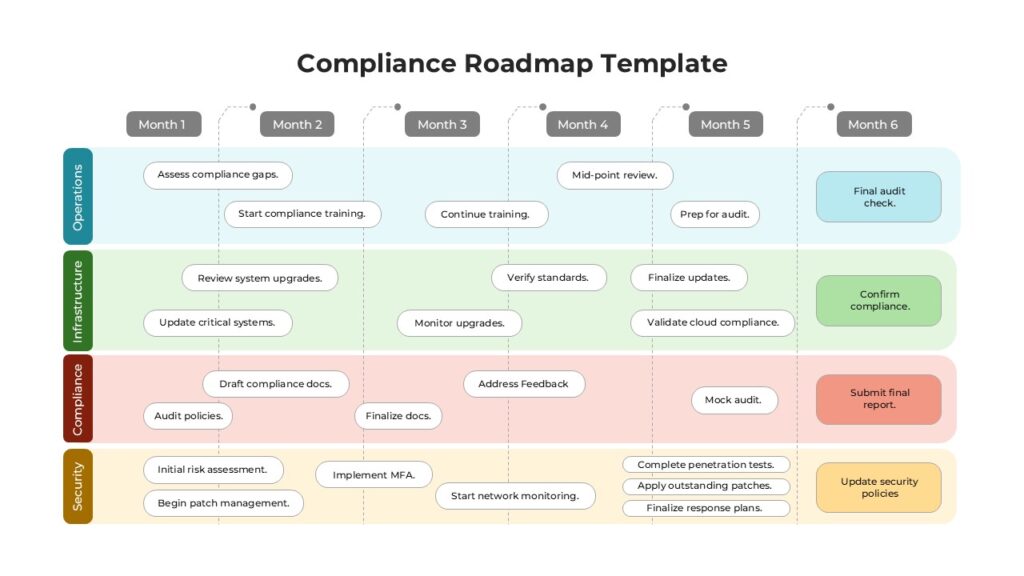
Visual overview of the 2025 compliance roadmap for small businesses (infographic).
Regulatory compliance isn’t just bureaucratic red tape reserved for corporate giants. For small businesses, it’s a matter of survival. A single oversight can trigger fines that erase months of profit, tarnish your reputation overnight, or even shut you down. This roadmap cuts through the noise, giving you a practical, step-by-step approach to safeguard your business without needing an expensive legal retainer. You’ll walk away with clear actions, not just theory.
Key Takeaways: Your 2025 Compliance Roadmap
- Data privacy: Know what personal data you collect, obtain proper consent, and secure it.
- Employment laws: Classify workers correctly, pay promptly, and maintain a safe, harassment-free workplace.
- Tax obligations: Meet quarterly estimated payments, sales tax collection, and payroll tax deadlines.
- Licenses & permits: Secure and renew all federal, state, and local licenses on time.
- Health & safety: Conduct walkthrough inspections, provide training, and keep documentation.
- Advertising rules: Tell the truth, disclose sponsorships, and comply with CAN-SPAM.
- Record-keeping: Maintain systematic digital and physical records as your defense in any audit.
Why Compliance Matters for Your Small Business
Compliance isn’t a burden—it’s a shield. The concrete risks of ignoring regulations include:
- Hefty fines: Even a single data privacy misstep can cost thousands under laws like GDPR or CCPA. Employment misclassification can lead to back wages and penalties that multiply quickly.
- Reputational damage: Customers flee when they hear you’ve mishandled their data or violated trust. A negative headline about a small business can spread faster than ever.
- Operational disruptions: An OSHA inspection or tax audit can pause your daily operations. Lost time, legal fees, and stress add up.
- Employee lawsuits: Wage-and-hour disputes, discrimination claims (including disability under ADA), or unsafe working conditions can lead to costly litigation—even if you eventually win.
- Loss of licenses or permits: If a required license lapses, you might have to halt sales or services until it’s reinstated.
- Data breaches: Without proper security, a breach can expose customer data, triggering notification obligations under state breach laws and destroying trust.
Proactive compliance protects your bottom line and your peace of mind. When you know the rules, you can focus on growth instead of firefighting.
Direct answer: Compliance matters because it prevents financial, legal, and reputational catastrophes that small businesses often can’t survive. It’s not optional; it’s fundamental to operating responsibly and durably.
How to Comply with Data Privacy Laws (GDPR, CCPA) as a Small Business
You don’t need to be a tech giant to handle personal data. If you collect names, emails, payment info, or even IP addresses, data privacy laws likely apply to you. The two heavyweights are:
- GDPR (General Data Protection Regulation): Protects EU residents’ data, regardless of where your business is based. If you have even one EU customer, you may need to comply.
- CCPA (California Consumer Privacy Act): Gives California residents rights over their personal information. Similar laws exist in other U.S. states, such as Virginia’s Consumer Data Protection Act (CDPA) and Colorado’s CPA.
What constitutes personal data? Anything that can identify a person: name, address, phone number, email, online identifiers, payment card details, and even behavioral data.
Consent requirements: Under GDPR, you must obtain clear, affirmative consent before collecting or using personal data; pre-checked boxes or silence do not count. While CCPA relies more on an opt‑out right for certain data sales, best practice is always to tell people exactly what you’re collecting and why, and make it as easy to withdraw consent as it was to give it. In some interpretations, sharing data for analytics or targeted advertising may be considered a “sale,” so review your practices carefully and consult the official California Attorney General’s CCPA guidance.
Practical, low-cost steps to secure customer information:
- Conduct a data inventory: Write down every type of personal data you collect, where it’s stored, who has access, and why you need it. Delete what you don’t.
- Update your privacy policy: Use plain language to describe what data you collect, how you use it, who you share it with, and how customers can exercise their rights (access, deletion, opt-out). Many website builders offer privacy policy templates.
- Use strong passwords and two-factor authentication (2FA): For every account holding customer data.
- Encrypt sensitive data: Full-disk encryption on devices, and TLS/SSL for your website.
- Limit access: Only employees who need the data to do their job should have it.
- Train your team: A 15-minute session on phishing, password hygiene, and data handling rules goes a long way.
- Have a breach response plan: Know who to contact and what steps to take if a breach occurs. Speed matters. Many states have data breach notification laws – be aware of your own state’s timeline.
Example: A small online bakery collects customer emails for a newsletter and stores shipping addresses. Under CCPA, if the bakery ever sells or shares that data (for example, with a marketing partner), it must provide a “Do Not Sell My Personal Information” link and a clear privacy policy. Because definitions can be broad, it’s safest to provide the link and to review the CCPA regulations or consult a professional. Placing the link and a transparent policy on the site helps avoid a potential fine.
Employment and Labor Law Essentials: Fair Pay, Safe Workplace
Even a single employee triggers a web of federal and state requirements. Here’s what you need to know, stripped down.
Fair Labor Standards Act (FLSA)
Sets federal minimum wage, overtime pay (time and a half for hours over 40 in a workweek), and child labor standards. The FLSA generally applies to enterprises with at least $500,000 in annual dollar volume of business. In addition, individual employees may be covered if they engage in interstate commerce or produce goods for interstate commerce. Many small businesses meet one of these thresholds, but some very small, local-only operations might not. Always check the Department of Labor’s FLSA coverage tool for your situation.
OSHA (Occupational Safety and Health Administration)
Requires a workplace free from recognized hazards. For an office, that means ergonomic basics, fire exits, and first-aid kits. For a workshop, it means machine guards, ventilation, and protective equipment. You must display the OSHA poster “Job Safety and Health: It’s the Law” where employees can see it.
Anti-Discrimination Laws
The Equal Employment Opportunity Commission (EEOC) enforces laws prohibiting discrimination based on race, color, religion, sex, national origin, age, disability (Americans with Disabilities Act), or genetic information. Harassment is included. Even with fewer than 15 employees (the usual threshold for some federal laws), many state laws have lower thresholds. Also, the Family and Medical Leave Act (FMLA) may apply if you have 50 or more employees.
Employee vs. Independent Contractor
Misclassifying a worker as a contractor when they function as an employee can lead to back taxes, overtime wages, and penalties. The IRS and Department of Labor look at the degree of control and independence. When in doubt, use the IRS Form SS-8 or consult a professional. A safe rule: if you dictate how, when, and where the work is done, they’re likely an employee. See our detailed guide, Worker Classification 101.
Basic compliance checklist for small employers:
- Verify minimum wage and overtime rates for your state (some are higher than federal).
- Post all required workplace posters (federal and state). Download free from agency websites.
- Maintain accurate time records for non-exempt employees.
- Provide a safe work environment—conduct a simple walkthrough hazard check.
- Adopt a written anti-harassment policy and communicate it.
- Ensure proper worker classification; document the rationale.
- Provide required training (e.g., harassment prevention in certain states).
Example: A small marketing agency with three full-time employees and two freelancers must ensure freelancers are genuinely independent (set their own hours, use their own tools, multiple clients) to avoid reclassification. The agency must also pay overtime if employees exceed 40 hours, even if they’re salaried, unless they meet very specific exemption tests.
Tax Compliance: Reporting, Deadlines, and Record-Keeping
The IRS wants its cut, and states want theirs. Small business tax obligations are manageable if you build a system.
- Estimated quarterly taxes: For federal income tax, if you expect to owe $1,000 or more, you generally must pay estimated taxes four times a year (April 15, June 15, September 15, January 15). This includes self-employment tax and income tax. Note: state thresholds and deadlines may differ; check with your state’s department of revenue.
- Sales tax collection: If you sell taxable goods or services, you must collect sales tax in states where you have a “nexus” (physical presence or significant economic activity). Register with the state, collect the tax, and file returns (monthly, quarterly, or annually).
- Employment taxes: If you have employees, you must withhold federal income tax, Social Security, and Medicare, and pay employer’s share. Deposit these taxes on time (usually semi-weekly or monthly) and file Form 941 quarterly.
- Annual income tax return: Sole proprietors use Schedule C; partnerships file Form 1065; S-corps file 1120S. The deadline is usually March 15 for pass-through entities and April 15 for sole proprietors.
Essential documentation practices to reduce audit risk:
- Separate business and personal accounts—no mixing. Use a dedicated business bank account and credit card.
- Keep every receipt, invoice, and bank statement, either digitally or physically. Organize by category (meals, travel, supplies).
- Maintain a mileage log for business vehicle use.
- Record asset purchases and depreciation schedules.
- Retain records for at least 3 years from the filing date, longer for employment tax records (4 years) and property records.
- Use cloud accounting software with automated bank feeds to reduce manual errors.
Example: A freelance graphic designer earning $80,000 a year must pay quarterly estimated taxes to avoid an underpayment penalty. She sets up a separate savings account, transfers 25-30% of each payment, and pays the IRS online every quarter. She also registers for sales tax in her home state because she designs and sells digital templates.
For more details, visit the IRS Small Business and Self-Employed Tax Center.
Industry-Specific Licensing and Permits
Almost every business needs some form of license or permit. Requirements vary by industry, location, and business activity.
How to identify what you need:
- Federal: Most small businesses don’t need federal licenses, except for specialized fields (alcohol, firearms, aviation, broadcasting, transportation). Check the SBA’s federal license list.
- State: Think professional licenses (cosmetology, accounting, real estate, healthcare), sales tax permits, and state business licenses. Visit your state’s business portal or secretary of state website.
- Local: City or county business license, zoning permits (be sure to check local ordinances if you operate from home), health department permits (restaurants, childcare), signage permits, and home occupation permits.
Maintenance and renewal: Licenses expire. Note renewal dates on your calendar (see the compliance calendar section). Keep physical copies displayed where required. If you change your business address, notify the issuing agency immediately.
Consequences of lapse: Operating without a valid license can result in fines, stop-work orders, and even criminal charges in regulated fields. Your insurance might also deny coverage for claims occurring during a lapse.
Example: A catering business needs a local health permit, a state sales tax license, and possibly a mobile food vendor permit if operating a truck. The owner checks the city’s permitting portal, applies online, and sets renewal reminders. Failing to renew the health permit could shut down a weekend’s events.
Health and Safety Standards: OSHA and Workplace Safety
OSHA covers most private sector employers and their workers. Even small businesses are not exempt from providing a safe workplace. Businesses with 10 or fewer employees that are in certain low-hazard industries (as defined by OSHA’s recordkeeping regulations) may be partially exempt from routine programmed inspections. However, any business can be inspected following an employee complaint, accident, or fatality. The duty to provide a hazard-free workplace always stands.
Simple workplace safety checklist:
- Walk through your workspace and note any tripping hazards, exposed wires, or blocked exits.
- Ensure fire extinguishers are accessible and inspected annually.
- Provide adequate lighting and ventilation.
- Maintain a first-aid kit; know the nearest emergency care.
- For hazardous substances, have Safety Data Sheets (SDS) accessible and train employees on safe use.
- If employees use ladders, power tools, or heavy equipment, provide appropriate training and personal protective equipment (PPE) at no cost to them.
- Post the OSHA poster and any state-specific safety notices.
Training mandates: Many OSHA standards require annual training. Topics can include emergency action plans, fire prevention, hazard communication, and specific equipment operation. Even a 20-minute video and discussion can satisfy the requirement.
Preparing for an OSHA inspection: If an inspector arrives, stay calm. You have the right to ask for the purpose of the inspection. Designate a person to accompany the inspector and take notes. Fix any minor issues immediately if possible. Documentation of your safety efforts (training logs, inspection checklists) demonstrates good faith. Most inspections are prompted by employee complaints or serious accidents.
Example: A small auto repair shop that handles corrosive materials like battery acid must have an eye-wash station accessible within 10 seconds of the hazard area. Additionally, the shop should have fire extinguishers and a written hazard communication program. The owner assigns one employee to be the safety point person, who keeps a binder with SDS sheets and training logs. During an OSHA inspection triggered by an employee complaint, the binder and observed clean floors prevented a citation. For shops that do not use corrosive chemicals, the eye-wash requirement may not apply, but it’s a prudent safety measure when chemicals are present.
Advertising and Marketing Rules: Truth in Advertising
The Federal Trade Commission (FTC) enforces truth-in-advertising laws. The core principle: ads must be truthful, not misleading, and backed by evidence. This applies to all media, including social media and influencer marketing.
Key FTC guidelines:
- Endorsements and testimonials: If you give a free product or pay someone for a review, that connection must be disclosed clearly. Phrases like “I got this for free, but my opinions are my own” work. See the FTC Endorsement Guides for specifics.
- Disclosures: Any limitations or conditions on an offer must be clear and conspicuous, not buried in fine print. A “free trial” that automatically converts to a paid subscription must disclose that fact prominently.
- Email marketing (CAN-SPAM Act): Every commercial email must have